

DJI Mavic, Air and Mini Drones
Friendly, Helpful & Knowledgeable Community
Join Us Now

jaystechvault

Active Member
Approved Vendor
Joined
Jan 29, 2024
Messages
32
Reactions
68
Age
24
Location
Raleigh, United States
Site
youtube.com
Finding a place where you can fly a drone is one thing.
Finding a place where you’ll actually enjoy flying is another.

Some locations are technically legal but stressful, crowded, or poorly suited for flying. Others might not look obvious on a map—but turn out to be excellent drone spots used by pilots all the time.

So how do you find the best places to fly your drone?

What makes a “good” drone flying spot?​

The best drone spots usually share a few traits:
  • Clear takeoff and landing areas
  • Minimal foot traffic or bystanders
  • Open sightlines and safe surroundings
  • Interesting scenery or landmarks
  • Low risk of enforcement issues
A location doesn’t need to be remote or dramatic—it just needs to be practical and flyable.

Why legality alone isn’t enough​

Many pilots rely solely on airspace maps or regulations to find places to fly.
That approach misses a big piece of the puzzle.

A location can be:
  • legal in the air
  • allowed on paper
  • but still a terrible place to fly

For example:
  • parks with heavy foot traffic
  • areas with conflicting or unclear enforcement
  • locations where pilots are frequently asked to leave

The best flying spots are often the ones that are known and used by other pilots, not just theoretically allowed.
Look for places pilots actually fly​

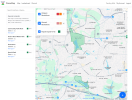
One of the most reliable ways to find good drone spots is to see where pilots already fly without issues.

1770328587591.png

When pilots repeatedly fly in the same locations, it usually means:
  • the area is workable in practice
  • takeoff and landing are tolerated or allowed
  • enforcement is minimal or predictable
  • the spot is suited to drone operations
This kind of real-world context doesn’t show up in airspace charts.

How I solved this problem:​

I got tired of guessing which places might be a good idea to fly. Instead I built DroneMap to surface popular drone locations based on real pilot activity, not guesses.
It combines:
  • pilot reviews and reports
  • repeat activity at locations
  • local context and rules around flying conditions

This makes it easier to:
  • discover proven flying spots
  • avoid locations that look good but don’t work
  • explore new areas with more confidence

Instead of starting from scratch, you’re learning from pilots who have already been there.

Check it out here:
 
All that info yet you never stated WHY you want to fly a drone, or WHAT you want to see, record, or photograph. Without a purpose it's all useless talk. And what's BEST for one may be of no interest to another.
Perhaps the OP is trying to provide a service to other drone operators regardless of the purpose of their flights, whether for photography or just because they want to bore holes in the sky, and he's inviting our participation in building a national database. It'll be a daunting task, but more power to him.

I guess I'm lucky. My neck of the woods has no shortage of dramatic desert and mountain scenery, and the Colorado River runs through it. I've never felt unduly restricted as to where I can fly, and I have no concerns about enforcement because I obey the law. I know that the national parklands and designated wilderness areas hereabouts are off limits, but I'm surrounded by millions of acres of other public lands. If, for some reason, I want to capture an aerial photograph of something within 5 NM of our airport, it's easy to request a temporary authorization via LAANC.

I can sympathize with those who live in more congested, settled areas with a paucity of wide-open spaces.
 
  • Like
Reactions: Rchawks
I applaud your attempt at this, but you need to use the correct language. When it comes to FAA and UAS regulations and/or restrictions, words matter.

When you click the rule at RDU (Raleigh Durhan), it says "You can't fly near airports. However you can fly closer with a LAANC waiver." There is no such thing as a "LAANC Waiver". LAANC is not a waiver. And you don't get LAANC at the link you provided. As a matter of fact, you can't get permission to fly at RDU on the Drone Zone unless you are a 107 and want to fly above UASFM (AGL Grids) limits, or want to tie an actual waiver to your airspace authorization.

In order to fly at RDU, you need a LAANC authorization from a LAANC Supplier. I use Aloft Air Control, but there are also others. You're sending people to the wrong place to get permission to fly in controlled airspace, and telling them to get a waiver instead of an airspace authorization.

And a waiver if a very specific authorization to fly outside operational restrictions. LAANC stands for Low Altitude Authorization and Notification Capabilities. It's simply a real time (for the most part) notification that provides forensic proof you have permission to fly there. You simply show up, sign on, and let the app know you're there.

I love what you're doing, and see it as a benefit to the hobby community. Just make sure you have the correct information on your map and it's associated links.

The only other thing I would change is that for the National Park link to rules. You mention, "You cannot fly a drone from inside the national park. You can fly over it while controlling it from outside. Take off and landing must also be outside." Which at face value is true. But you still need to maintain FAA regs. And stuff such as flying within VLOS is still required.

Just a word of caution.
 
I put in my location in CT and there is no data. Zooming out, it seems the only data shown on the map is in NC and TN. Is that simply because the site is brand new and there is not yet much (any) crowdsourced data?
 
I use Google Maps a lot to get an idea of the terrain.

I prefer terrain with varied altitudes, like cliffs over water or mountains/hills as opposed to flat landscapes.

So Google Maps or Google Earth lets you get an idea, using topographic or satellite photos.

Of course Street View is also very helpful because often Street View of 360 pano drones are posted in Google Maps.

Then I figure out what the drone laws are, if the area involved has a lot of restrictions. Often there are, for instance, I posted about Bixby Bridge in CA recently and there are several spectacular drone 360 panos posted on Street View.

But this area is blocked from drone flights.

So you have to do some research.
 
  • Like
Reactions: GadgetGuy
Finding a place where you can fly a drone is one thing.
Finding a place where you’ll actually enjoy flying is another.

Some locations are technically legal but stressful, crowded, or poorly suited for flying. Others might not look obvious on a map—but turn out to be excellent drone spots used by pilots all the time.

So how do you find the best places to fly your drone?

What makes a “good” drone flying spot?​

The best drone spots usually share a few traits:
  • Clear takeoff and landing areas
  • Minimal foot traffic or bystanders
  • Open sightlines and safe surroundings
  • Interesting scenery or landmarks
  • Low risk of enforcement issues
A location doesn’t need to be remote or dramatic—it just needs to be practical and flyable.

Why legality alone isn’t enough​

Many pilots rely solely on airspace maps or regulations to find places to fly.
That approach misses a big piece of the puzzle.

A location can be:
  • legal in the air
  • allowed on paper
  • but still a terrible place to fly

For example:
  • parks with heavy foot traffic
  • areas with conflicting or unclear enforcement
  • locations where pilots are frequently asked to leave

The best flying spots are often the ones that are known and used by other pilots, not just theoretically allowed.

Look for places pilots actually fly​

One of the most reliable ways to find good drone spots is to see where pilots already fly without issues.

View attachment 187796

When pilots repeatedly fly in the same locations, it usually means:
  • the area is workable in practice
  • takeoff and landing are tolerated or allowed
  • enforcement is minimal or predictable
  • the spot is suited to drone operations
This kind of real-world context doesn’t show up in airspace charts.

How I solved this problem:​

I got tired of guessing which places might be a good idea to fly. Instead I built DroneMap to surface popular drone locations based on real pilot activity, not guesses.
It combines:
  • pilot reviews and reports
  • repeat activity at locations
  • local context and rules around flying conditions

This makes it easier to:
  • discover proven flying spots
  • avoid locations that look good but don’t work
  • explore new areas with more confidence

Instead of starting from scratch, you’re learning from pilots who have already been there.

Check it out here:
I so wanted this to be helpful. It shows three ‘’popular places to fly” in the entire U.S.
 
I can't imagine relying on others for suggestions as to where I might want to fly. Ditto lists of top-ten attractions or where-to-go tourist tips and photo opportunities. I'm familiar with my home territory and, even when I travel, I can quickly assess the suitability of a place for flying. There are already abundant apps with maps that define restricted areas, but none which indicate that a site might be too crowded or too stressful, whatever that means. Do I miss some opportunities when on the road? No doubt. Would I want to go someplace to capture aerial photos of some feature that's already been documented by countless others? No.

I sometimes visit a website populated by Nikon enthusiasts. Someone posts a picture of the Mormon barns at Grand Teton NP (photogenic for sure), and then, in the next year, scores of unimaginative lemmings feel compelled to go there , capture the same scene, and post their results. Absent different skies and seasonal changes in vegetation, there's nothing distinctive about any of their work.
 

DJI Drone Deals

New Threads

Forum statistics

Threads
140,278
Messages
1,657,464
Members
168,272
Latest member
Sailor Sea
Want to Remove this Ad? Simply login or create a free account