

DJI Mavic, Air and Mini Drones
Friendly, Helpful & Knowledgeable Community
Join Us Now

Lost my other drone, my Mini 3 Pro

I think this matter has gotten as much attention as it needs. More, actually. Either you get it, or you don't. Nobody is going to change any minds.
 
  • Like
Reactions: Torque
Given how far the drone was from the RC and how much obstruction was between the RC and the drone flying so low, I expect a combination of factors resulted in signal loss shortly before an ocean wave rose up and hit it, so the final VPS data showing 0-4ft is missing from the logs on the RC.

I've wondered whether the cloud of saltwater spray that hit the drone has any immediate effects on its operation.
 
Because the screen capture shows thus. 10 feet in orange.

It's not a subjective opinion if I can see it's height in orange numbers on the screen capture.
If you saw 10 ft in orange letters on your screen capture,then I guess your drone must have been 10 feet above the sea (for the fraction of a second when that screen shot shows).

It seems that you've not learned a thing from any of your lost drone incidents.
There's much more to flying a drone over the sea than you are aware of.
But the ocean is not dead flat and a hovering drone doesn't stay a fixed distance above the water.
Ocean swells rise and fall, coming closer and falling away from the hovering drone and always changing.

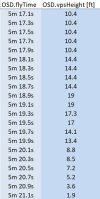
Here are some numbers to consider.
They show the VPS height (in feet) of your drone recorded at 0.1 second intervals for the last 4 seconds of your flight.
i-446JwjX-L.jpg


Are you still confident that your drone was 10 feet above the water ??
 
How about this question:

Our man swears to his 10 feet above wave..correct?

He is basing his altitude from takeoff. Assuming it is beach elevation, let's call that 0 feet AGL...?

Waves in video looked to be 8 to 10 feet at least, correct?
(wide angle lens makes them look smaller, though they could be 10 feet plus. Fair?l

Here is the question:

can the lower part of an ocean swell be lower than the beach?

Here is the response I found:

Yes, the lower part of an ocean swell (the wave trough) can be lower than the elevation of the beach, particularly at low tide or during large wave events. As waves approach the coast, they undergo a process called shoaling, where they slow down, shorten in wavelength, and increase in height. This often causes the trough to dip below the average water level, which, combined with the sloping nature of the beach, can make the lowest part of the wave lower than the exposed sand, especially when the water level is drawn down just before a large wave breaks.


Now, I don't know what any of that means, but could he have been correct?
He was in fact 10 feet above the lowest part of a 12 foot wave when his drone was then hit by the zenith of the swell.

Either way my man, you crashed your drone into the ocean again. Good news is, you probably have lots of parts you could sell.
 
  • Like
Reactions: Torque
How about this question:

can beach weather affect barometric altimeter


Response:

Yes, beach weather significantly affects barometric altimeters because they measure altitude by sensing changes in air pressure, and weather systems (like storms or clear skies) cause pressure shifts, making devices read higher or lower than true elevation unless calibrated, with temperature and humidity adding further variables. Changes from a high-pressure sunny day to a low-pressure stormy day can make a stationary device seem to gain or lose hundreds of feet in elevation.


Hmmmm...did the skies look like a storm was coming, or recently passed?
 
  • Like
Reactions: Torque
And then just for fun:

why did my mini 3 pro crash into the ocean


Response:

Your DJI Mini 3 Pro likely crashed into the ocean due to its downward vision sensors getting confused by the water's reflective surface, causing erratic flight, especially at low altitudes, combined with potential signal interference, battery voltage drops, or strong wind currents near the water, all exacerbated by water's disruption of radio signals. Water confuses sensors, making the drone think it's at a different height, leading to unexpected landings or loss of control, with salt water accelerating corrosion.


IMG_20260112_091151.gif
 
I guarantee you that if you put on some wide-angle lens glasses and drove your car, you would have a crash, because you would be mis-judging distances. Have you ever noticed the etched writing in right-side rear-view mirrors, "Objects in mirror are closer than they appear"?

Did you know it is common for people to back into things and crash because of this?

What you judged to be 10 feet through the 24mm camera was without a doubt much less.

You can either be a fool and keep insisting the camera view was a good way to determine close proximity, or you can be smart and learn from this and adjust your behavior and flying practices.

So far it seems you're choosing the former, given how stubbornly you're insisting the camera view was sufficient to accurately judge how far away the waves below you were, and just as importantly, how big and how high.
I will research what is considered wide angle and get back to you. The key parameter is FOV, not mm.

The DJI Mini 3 Pro's native Field of View (FOV) is 82.1° (24mm equivalent).

I thought 90 was a normal FOV.
 
If you saw 10 ft in orange letters on your screen capture,then I guess your drone must have been 10 feet above the sea (for the fraction of a second when that screen shot shows).

It seems that you've not learned a thing from any of your lost drone incidents.
There's much more to flying a drone over the sea than you are aware of.
But the ocean is not dead flat and a hovering drone doesn't stay a fixed distance above the water.
Ocean swells rise and fall, coming closer and falling away from the hovering drone and always changing.

Here are some numbers to consider.
They show the VPS height (in feet) of your drone recorded at 0.1 second intervals for the last 4 seconds of your flight.
i-446JwjX-L.jpg


Are you still confident that your drone was 10 feet above the water ??
Obviously when it crashed it wasn't 10 feet above the water. If I hovering drone doesn't stay at the same altitude when it's over water, that's news to me. Why wouldn't it? But I like your chart. Read my new post at the end, and it will surprise you. It sure surprised me!
 
So I just watched the screen capture again, to see if the barometric altitude stayed the same when it hit the water, indicating the water was rising. To my shock, that barometric altitude actually went up during the crash. First to 30 feet, then to 40 feet! Very strange.
 
  • Like
Reactions: Cafguy
Why wouldn't it?
Really This isnt star trek..... basic scientific principles apply.....If you rely on a cam and sensors to tell you what is going on then you should expect some inaccuracies and mistakes...Water is a reflective surface and no matter what anyone tells you electronic systems and sensors suffer from Glint errors... If you do not think this Go to Walmart and purchase a large Mirror and try to land your DJI Drone on it.
 
  • Like
Reactions: Torque
So Google said this:

There's no single "normal" FOV, as it varies greatly by application, but standard ranges often fall between 50° to 80° for balanced general use (like portrait/document photos or basic security), while wide-angle lenses (60°-110° for landscapes/rooms) and telephoto lenses (10°-25° for distant subjects) are common, with action cameras pushing even wider (100° to 180°+) and specialized cameras going very narrow. The best FOV depends on the subject: wide for big scenes, narrow for details.

To me, a proper FOV should make it so objects should not change their apperance(width) as you rotate the drone. I think, unfortunately, DJI drones do not do this. I notice objects on the far sides or the image get bigger. They shouldn't do that. I hate fisheye effects. With my Osmo 5 Pro I have to zoom in 2x to get rid of the fisheye effect.

But even if the view I got wasn't exact, it was pretty close. Also, my gimbal was pointed down 16 degrees.
 
Really This isnt star trek..... basic scientific principles apply.....If you rely on a cam and sensors to tell you what is going on then you should expect some inaccuracies and mistakes...Water is a reflective surface and no matter what anyone tells you electronic systems and sensors suffer from Glint errors... If you do not think this Go to Walmart and purchase a large Mirror and try to land your DJI Drone on it.
But this altitude isn't measured by optics. It's measured by barometric pressure.
 
Sorry but I am getting lazy tonight No offense I enjoy the science of the conversation BUT: Puppy PI Tells me.


"Flying over water creates barometric inaccuracies because the lack of ground features and consistent pressure readings (compared to land) can trick altimeters and pilots, leading to illusions of higher or lower altitude, especially with temperature changes or uncorrected pressure settings, making pilots fly dangerously low or high, so proper setting and cross-checking against GPS/terrain are crucial
. The main issues are the pressure difference between sea level and warmer/colder air masses and the lack of visual cues, causing pilots to misinterpret their height above the ground (AGL)"
 
Last edited:
  • Like
Reactions: jwilson
Sorry but I am getting lazy tonight No offense I enjoy the science of the conversation BUT: Puppy PI Tells me.


"Flying over water creates barometric inaccuracies because the lack of ground features and consistent pressure readings (compared to land) can trick altimeters and pilots, leading to illusions of higher or lower altitude, especially with temperature changes or uncorrected pressure settings, making pilots fly dangerously low or high, so proper setting and cross-checking against GPS/terrain are crucial
. The main issues are the pressure difference between sea level and warmer/colder air masses and the lack of visual cues, causing pilots to misinterpret their height above the ground (AGL)"
Who is Puppy PI? Is that Google? I can see that barometric pressure around big waves wouldn't be that accurate. But my whole flight out there, the altitude was fairly constant. So I will wait for DJI to tell me exactly what happened. But thanks for your comment. You know more about this than I do.
 
If a hovering drone doesn't stay at the same altitude when it's over water, that's news to me. Why wouldn't it?
I did not say that the hovering drone doesn't maintain altitude.

Here's what I said ......
But the ocean is not dead flat and a hovering drone doesn't stay a fixed distance above the water.
Ocean swells rise and fall, coming closer and falling away from the hovering drone and always changing.


But I like your chart. Read my new post at the end, and it will surprise you. It sure surprised me!

I can see that barometric pressure around big waves wouldn't be that accurate.
Waves have no effect on air pressure that you'd notice.
So I just watched the screen capture again, to see if the barometric altitude stayed the same when it hit the water, indicating the water was rising. To my shock, that barometric altitude actually went up during the crash. First to 30 feet, then to 40 feet! Very strange.
It wasn't strange at all.
Your drone maintained height except when you gave it some left stick to climb or descend.
 
  • Like
Reactions: Mrktn and Tower669

DJI Drone Deals

New Threads

Forum statistics

Threads
140,177
Messages
1,656,356
Members
168,209
Latest member
PeteJRZ
Want to Remove this Ad? Simply login or create a free account