


YorksPhotos
Well-Known Member
This one may be a lost cause. In complete denial. If he could see that he has been reckless he would wreck less. Until then they will continue to drop, 9 then 10 then . . . .
Given how far the drone was from the RC and how much obstruction was between the RC and the drone flying so low, I expect a combination of factors resulted in signal loss shortly before an ocean wave rose up and hit it, so the final VPS data showing 0-4ft is missing from the logs on the RC.
Because the screen capture shows thus. 10 feet in orange.
If you saw 10 ft in orange letters on your screen capture,then I guess your drone must have been 10 feet above the sea (for the fraction of a second when that screen shot shows).It's not a subjective opinion if I can see it's height in orange numbers on the screen capture.


I will research what is considered wide angle and get back to you. The key parameter is FOV, not mm.I guarantee you that if you put on some wide-angle lens glasses and drove your car, you would have a crash, because you would be mis-judging distances. Have you ever noticed the etched writing in right-side rear-view mirrors, "Objects in mirror are closer than they appear"?
Did you know it is common for people to back into things and crash because of this?
What you judged to be 10 feet through the 24mm camera was without a doubt much less.
You can either be a fool and keep insisting the camera view was a good way to determine close proximity, or you can be smart and learn from this and adjust your behavior and flying practices.
So far it seems you're choosing the former, given how stubbornly you're insisting the camera view was sufficient to accurately judge how far away the waves below you were, and just as importantly, how big and how high.
The same places they always are.Where did you see any distance ranges or references on the screen?
Obviously when it crashed it wasn't 10 feet above the water. If I hovering drone doesn't stay at the same altitude when it's over water, that's news to me. Why wouldn't it? But I like your chart. Read my new post at the end, and it will surprise you. It sure surprised me!If you saw 10 ft in orange letters on your screen capture,then I guess your drone must have been 10 feet above the sea (for the fraction of a second when that screen shot shows).
It seems that you've not learned a thing from any of your lost drone incidents.
There's much more to flying a drone over the sea than you are aware of.
But the ocean is not dead flat and a hovering drone doesn't stay a fixed distance above the water.
Ocean swells rise and fall, coming closer and falling away from the hovering drone and always changing.
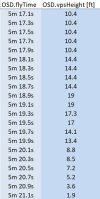
Here are some numbers to consider.
They show the VPS height (in feet) of your drone recorded at 0.1 second intervals for the last 4 seconds of your flight.
Are you still confident that your drone was 10 feet above the water ??
Really This isnt star trek..... basic scientific principles apply.....If you rely on a cam and sensors to tell you what is going on then you should expect some inaccuracies and mistakes...Water is a reflective surface and no matter what anyone tells you electronic systems and sensors suffer from Glint errors... If you do not think this Go to Walmart and purchase a large Mirror and try to land your DJI Drone on it.Why wouldn't it?
But this altitude isn't measured by optics. It's measured by barometric pressure.Really This isnt star trek..... basic scientific principles apply.....If you rely on a cam and sensors to tell you what is going on then you should expect some inaccuracies and mistakes...Water is a reflective surface and no matter what anyone tells you electronic systems and sensors suffer from Glint errors... If you do not think this Go to Walmart and purchase a large Mirror and try to land your DJI Drone on it.
Who is Puppy PI? Is that Google? I can see that barometric pressure around big waves wouldn't be that accurate. But my whole flight out there, the altitude was fairly constant. So I will wait for DJI to tell me exactly what happened. But thanks for your comment. You know more about this than I do.Sorry but I am getting lazy tonight No offense I enjoy the science of the conversation BUT: Puppy PI Tells me.
"Flying over water creates barometric inaccuracies because the lack of ground features and consistent pressure readings (compared to land) can trick altimeters and pilots, leading to illusions of higher or lower altitude, especially with temperature changes or uncorrected pressure settings, making pilots fly dangerously low or high, so proper setting and cross-checking against GPS/terrain are crucial
. The main issues are the pressure difference between sea level and warmer/colder air masses and the lack of visual cues, causing pilots to misinterpret their height above the ground (AGL)"
I did not say that the hovering drone doesn't maintain altitude.If a hovering drone doesn't stay at the same altitude when it's over water, that's news to me. Why wouldn't it?
But I like your chart. Read my new post at the end, and it will surprise you. It sure surprised me!
Waves have no effect on air pressure that you'd notice.I can see that barometric pressure around big waves wouldn't be that accurate.
It wasn't strange at all.So I just watched the screen capture again, to see if the barometric altitude stayed the same when it hit the water, indicating the water was rising. To my shock, that barometric altitude actually went up during the crash. First to 30 feet, then to 40 feet! Very strange.









We use essential cookies to make this site work, and optional cookies to enhance your experience.


